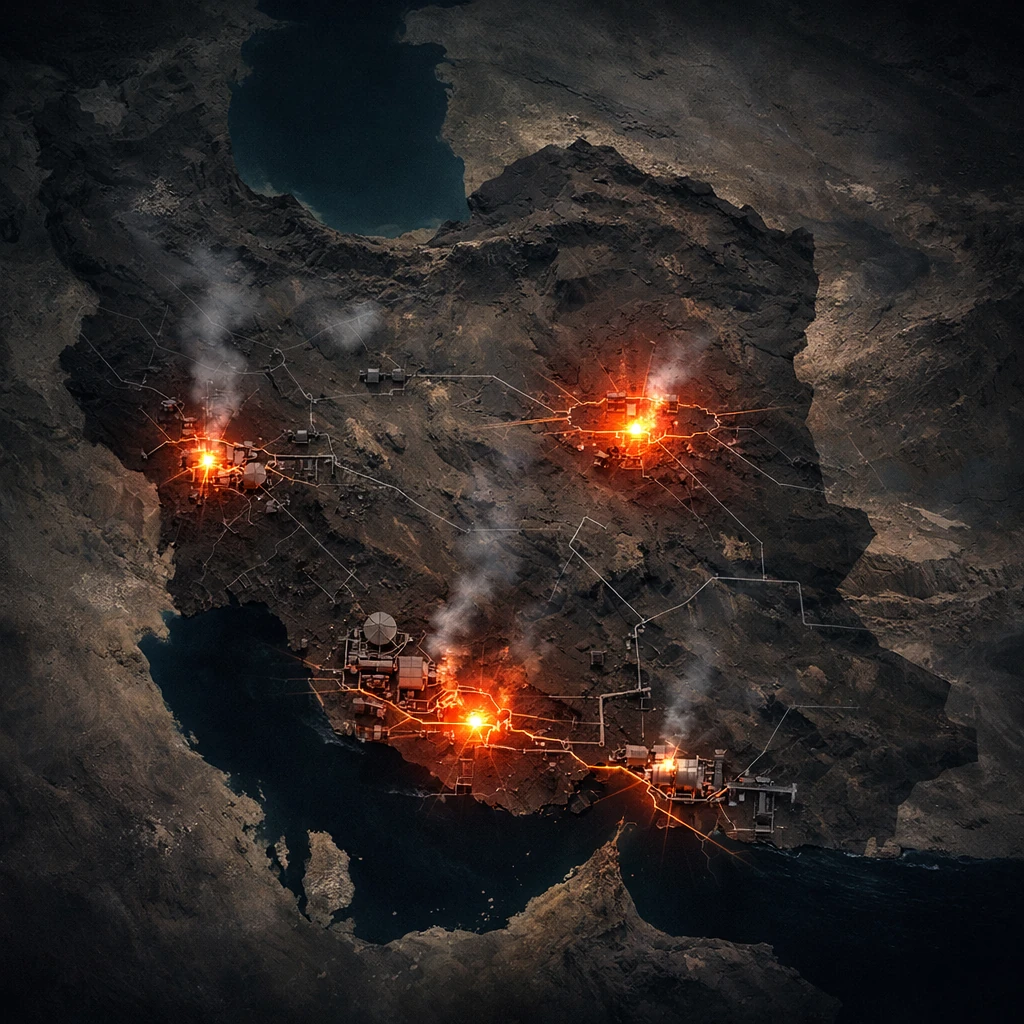
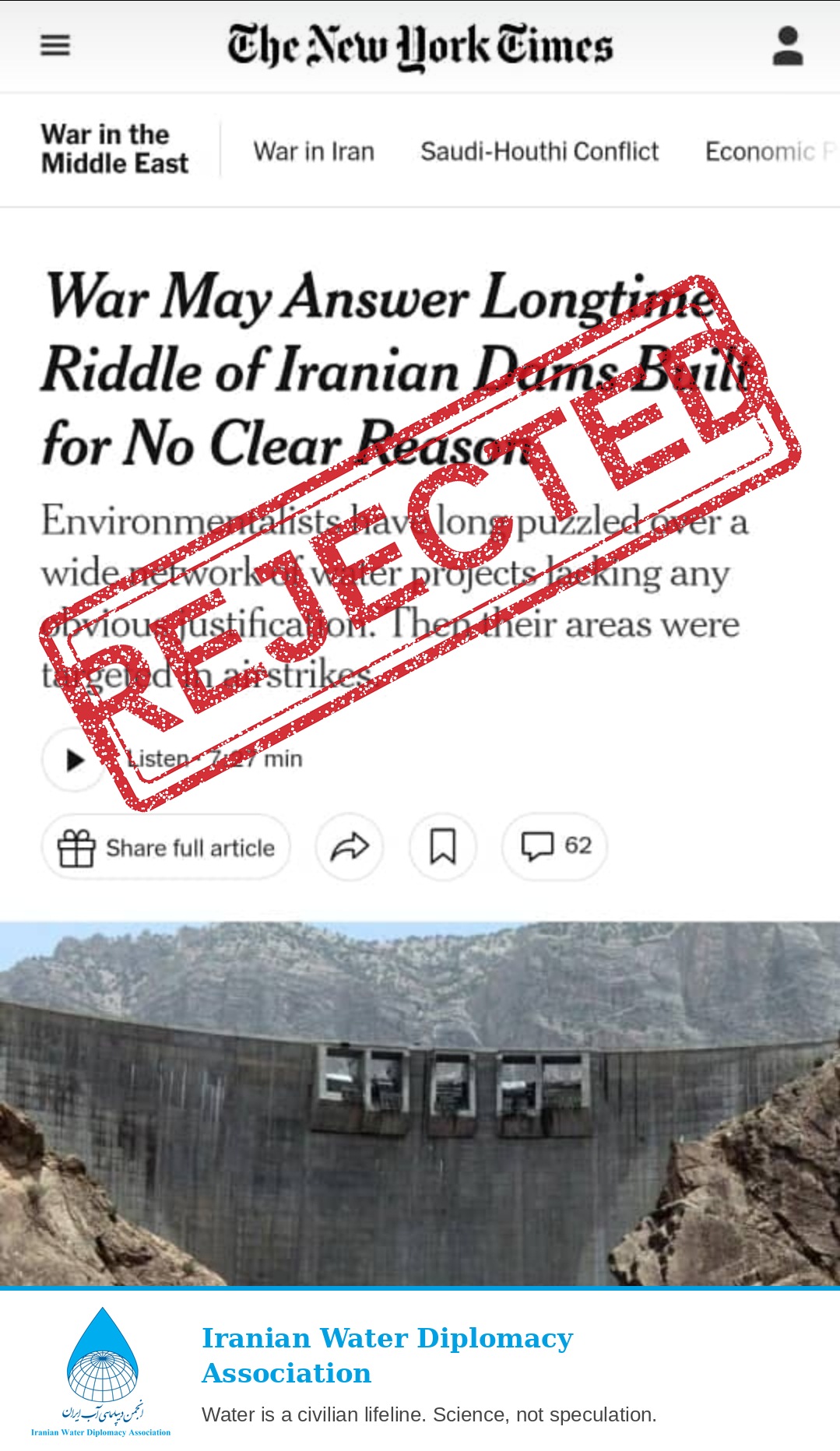
The Iranian Water Diplomacy Association notes with serious concern the New York Times report of November 16, 2026, titled “War May Answer Longtime Riddle of Iranian Dams Built for No Clear Reason.” Pointing to a geographic overlap between certain dams and water projects and areas struck in the recent hostilities, the report suggests that some of this infrastructure may have been designed or built to supply water and energy to underground military facilities. The report itself acknowledges that the evidence is largely circumstantial and inconclusive.
The Association supports transparency, independent review and scientific accountability in water-resources development. But attributing military purposes to vital water infrastructure without credible, verifiable evidence carries serious scientific, humanitarian, legal and security consequences. We therefore draw attention to the following.
1. Geographic overlap is not proof of military purpose
Dams, tunnels and water-transfer lines are built where topography, runoff, elevation difference and geology allow, which in Iran means mostly mountainous terrain and river valleys. Military facilities may be sited in the same regions for entirely different reasons. Proximity between the two shows neither a functional relationship nor a military purpose in the design and construction of water infrastructure.
The report’s reference to 533 identified dams, without a statistical analysis, has no evidentiary value. A credible assessment would state how many dams lie near confirmed military sites, at what distances, what share of all dams this represents, and how that compares with the natural distribution of dams in comparable mountainous terrain. It would use established spatial, hydrological, engineering and geospatial methods to test whether the overlap exceeds what siting constraints alone explain. It would also distinguish between the location of a strike, the location of a verified military facility, and the location of a water project. A strike location does not, by itself, prove that a military facility exists near a dam.
Historical chronology also does not fit the hypothesis. Some of the country’s most prominent dams, including Amir Kabir (Karaj), Dez and Karun-1 (Shahid Abbaspour), were designed and built in the 1960s and 1970s, decades before what is now called Iran’s “missile cities” took shape. Such dams cannot have been built to serve those facilities. Any claim of military function must therefore be examined project by project, with evidence on the timing of design, construction and operation, and cannot be generalized to the country’s entire dam network.
2. Military purpose, dual use and incidental use are different things
Large underground facilities may need reliable water and energy, like any complex installation. That need does not prove that dams or water-transfer projects were designed or built to meet it. Three situations must be kept apart: a military purpose in a project’s design and construction; incidental or dual use of a civilian facility; and the possible use of the public water and power network by a military facility. They are not equivalent scientifically, technically or legally, and establishing any one of them requires specific evidence on design, siting, financing, resource allocation and actual operation.
Iran faces structural water limits, uneven rainfall in time and space, recurrent drought and growing pressure on its resources. Its dams and transfer networks, developed under decades of water-management policy, support drinking water, agriculture, flood control, hydropower and the livelihoods of millions. Questions or disagreements about the justification of particular projects are legitimate and are debated by Iranian scientists themselves. But a project that is poorly justified is not thereby military.
3. When war is treated as evidence
The report’s headline raises the possibility that war may answer a riddle about Iran’s dams. This framing makes a military strike an instrument for discovering, or proving, the function of civilian infrastructure, as though being targeted showed the nature of what lies in an area. That reasoning is circular: a region is struck, and the strike is then used to interpret the purpose of the infrastructure there. In wartime, such a narrative can, knowingly or not, help justify further attacks on water infrastructure. The Association rejects any narrative that creates that opening, given its dangerous consequences for civilian lives.
Water and its facilities are basic to human security, public health, food security and environmental sustainability. Presenting water infrastructure as military, without credible evidence, blurs the line between civilian objects and military targets in public opinion and normalizes a threat-based view of facilities on which millions depend. It can also erode trust, regional cooperation and diplomatic efforts to manage shared water, especially in a region already strained by water and political tensions. Destroying water infrastructure would, beyond its direct human toll, harm downstream flows, agriculture, wetlands, biodiversity and local livelihoods, effects that can cross political borders. Protecting water infrastructure is a shared regional and international responsibility.
4. International humanitarian law protects water infrastructure
Because water is vital to civilian survival, international humanitarian law gives specific protection to water installations. Drinking-water facilities and irrigation works are protected as objects indispensable to the survival of the civilian population, and dams and other works containing dangerous forces receive special protection because their destruction can have catastrophic consequences. Articles 54 and 56 of Additional Protocol I (1977) to the Geneva Conventions address these two categories, and customary international humanitarian law supports the same protections.
Three rules deserve particular emphasis. First, under Article 52(3) of Additional Protocol I, in case of doubt whether an object normally dedicated to civilian purposes is making an effective contribution to military action, it must be presumed not to be. Speculation or inconclusive circumstantial evidence therefore cannot justify an attack. Second, Article 54(3) prohibits actions against objects indispensable to civilian survival that may be expected to leave civilians with inadequate water, even where such objects are used by armed forces. Third, under Article 56(2), special protection for a dam may cease only where it is used in regular, significant and direct support of military operations and an attack is the only feasible way to end that support. Rules 42 and 54 of the ICRC’s study on customary international humanitarian law likewise treat particular care in attacking dams and works containing dangerous forces, and the prohibition of attacking objects indispensable to civilian survival, as customary law.
Merely alleging dual use for a water facility does not automatically make it a lawful military objective or end its legal protection. The principles of distinction, proportionality and precautions in attack must be respected. No media narrative or unproven claim should replace a careful legal assessment of a facility’s status.
5. The responsibility of the media
International media have a responsibility beyond publishing a hypothesis. On issues with these humanitarian and legal consequences, they must clearly separate verified data, circumstantial evidence, expert hypotheses and speculation, and should consult experts in hydrology, water engineering, environmental science, political geography, remote sensing and international law. Reports alleging links between dams and military facilities should publish their spatial-analysis methods, selection criteria, distance and overlap data, and independent evidence of functional links, so that scientific verification is possible. They should also distinguish an expert’s view that a hypothesis is technically possible from evidence that proves it in a specific case. Unproven hypotheses presented as firm statements or suggestive headlines can heighten suspicion, securitize water and weaken international norms protecting civilian infrastructure.
Our position
The Iranian Water Diplomacy Association:
• Calls on international media to consult independent, qualified experts on water-infrastructure and security issues, and to distinguish documented evidence from unproven hypotheses.
• Calls on media to avoid headlines and framings that present military strikes as a means of discovering or proving the military function of civilian infrastructure.
• Invites researchers and commentators to consider the methodological limits, and the humanitarian, legal and security consequences, before making firm statements about the function of water infrastructure.
• Calls for transparency about the data, maps, spatial-analysis methods and technical criteria used in reports alleging links between water infrastructure and military facilities, so that independent scientific assessment is possible.
• Rejects any narrative that, directly or indirectly, helps justify attacks on dams and vital water infrastructure, and stresses that all parties must abide by the protections international humanitarian law gives these facilities.
• Affirms that scientific cooperation, transparent data exchange, expert dialogue and evidence-based diplomacy are the only sustainable path to managing water and easing water tensions in West Asia and elsewhere.
The Association stands ready to put its scientific and technical expertise at the disposal of media, research centers and international institutions. Water must not become a casualty of geopolitical conflict. Protecting vital water infrastructure is a shared responsibility toward people, the environment and future generations.
Iranian Scientific Association for Water Diplomacy
Tuesday, November 17, 2026